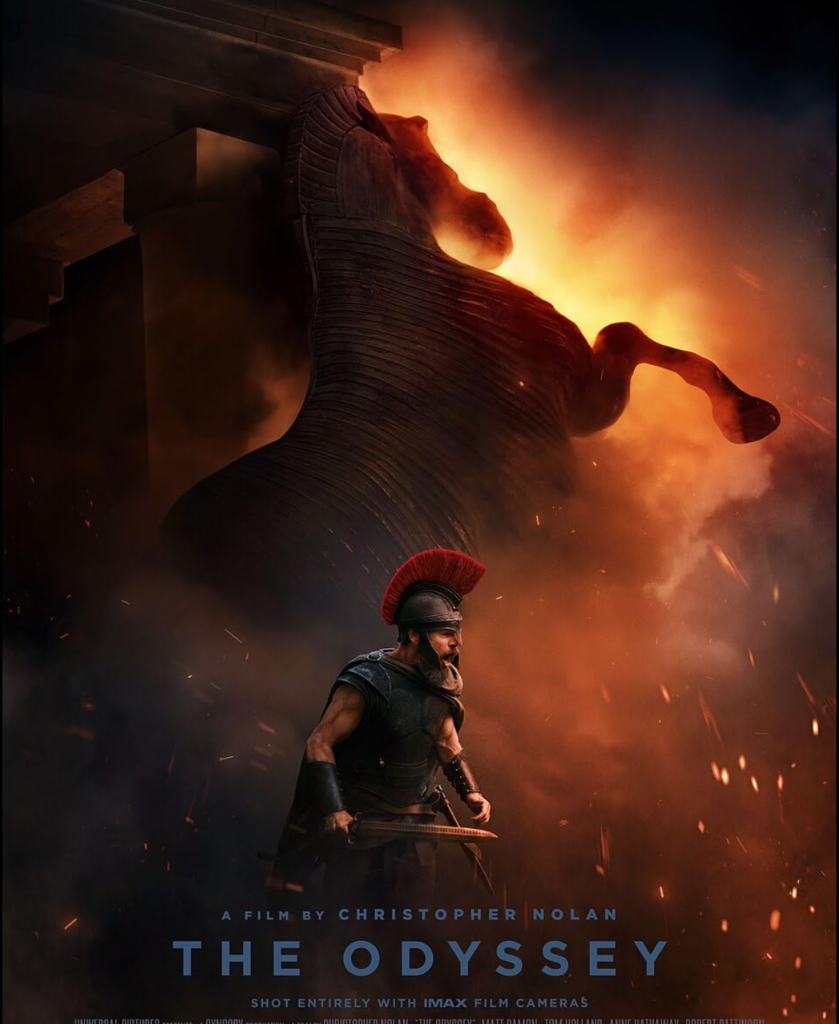
I just saw The Odyssey last night. Let’s dispense with some housekeeping before we do a deeper dive.
See it in Imax if you can. I’ve had a handful of people whose opinions I value say it doesn’t matter. It does. I saw it in Cherry Hill, New Jersey in a pristine theater from the third row balcony in cushy, plush armchairs. The laser scan print was also pristine. It comfortably filled over 120° of my field of vision without distortion at the edges and the whipsaw neck strain that can accompany less skillful Imax offerings. The man shot in Imax after all. He didn’t shoot 35 or 70 mm and upconvert in post to feed the Imax market. The film deserves to be seen in the format it was shot in.
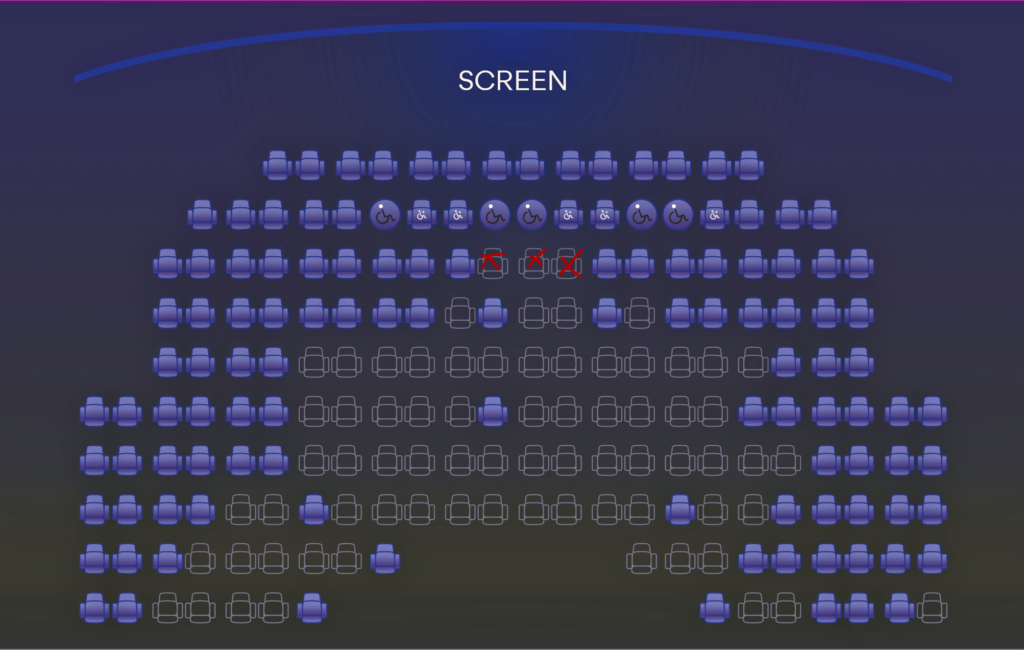
So find the theater with the largest screen, best projection and sound and settle in, because if Nolan is good at anything it’s in creating a fantastic ride. Superior projection that takes up 120 degrees and sounds of battle and feasting that rumble in your solar plexus is something you want to avail yourself of. In my opinion, I’ve only seen a handful of films that truly benefit from and deserve to be seen in Imax and this is one of them.
There are those among us who find the Nolan version of this 3,000-year-old epic poem/novella stripped down and lacking the sophistication of the original. My sense is that this lack of nuance is intentional, that Nolan wasn’t looking to recreate the mythology of Homer as much as to recreate a more realistic-feeling depiction of events that inspired the epic poem and poet to mythologize. The Pantheon of Greek gods is absent and even Zendaya’s Pallas Athena, the bringer of wisdom, wears the face of a Trojan woman that guilt-wracked Odysseus saw slaughtered in front of him in the rage and bloodlust of the sacking of Troy. The original monsters are there, because heck, monsters and film go together like baclava and Turkish coffee.
The Real Troy for real
For much of modernity, (the 19th and 20th centuries) the existence, location and timeline of Troy were debated. Modern archaeology has produced definitive evidence of a real city at Hisarlik, in modern Turkey. What remains to debate is which layer of that city (if any) corresponds to Homer’s Troy. Excavations unearthed nine major layers (Troy I–IX), showing continuous occupation from ~3000 BCE to Roman times. The upper layers include fortifications, houses, and evidence of destruction consistent with warfare. Heinrich Schlieman, the German archaeologist who found the site, also dug clumsily and too aggressively which destroyed evidence that might have pinpointed which layer was Homer’s Troy. But bottom line– Troy did exist.
The Real Bard–You can’t go Homer again
Homer’s existence is more uncertain, but one thing is conclusively locked in; he didn’t write anything. Some ancient sources treat him as a real poet, a sort of oral editor/aggregator of Bronze Age tales, but modern linguistic scholars citing linguistic variations in the written text, find no definitive evidence he was a single historical person. As a blind, illiterate poet, he was certainly no “writer” in our sense of the word, rather part of a rich oral tradition where poets (aoidoi) performed long epics from memory using formulaic building blocks.
Meter, dactylic hexameter, provided rhythmic scaffolding and narrative units. Repetition and recurring phrases, (e.g., “rosy‑fingered Dawn”) along with a pat sequence of scenes (feasts, arrivals, laments) were familiar plot devices that helped both listeners anticipate and follow long narratives and helped the oral storyteller sequence, remember and retell them with his own flourishes. If you’ve ever listened to modern storytellers, you’ll find they use same types of formulas and mnemonics that the ancient bards used. There is literally nothing new under the sun.
So, if Homer (singular) even existed, rather than a plurality of Homeric poets, he likely lived in the 9th–8th century BCE, a period when writing in Greece was rare and used mainly for short inscriptions. Greece wouldn’t have a written alphabet (which they’d appropriated from the Phoenicians) for another hundred years or so. Then it would take another hundred years after that for long literary texts to be transcribed.
Relax, reinterpretation is okay.
In my opinion, the fact that no single “fixed” version existed until writing stabilized the text, gives any reteller of the tale some pretty broad latitude for reinterpretation, including its most modern retellers like academic translator Emily Wilson and filmmaker translator Christopher Nolan. Auteur Nolan can’t help but inject self-referential themes, the sweep of battle in Dunkirk, the clever Odysseus, like Oppenheimer, creator of a super weapon, who lives to bitterly regret its deployment. His Odysseus is plagued with memory gaps, shades of Guy Pearce’s Leonard Shelby in Nolan’s Memento, avenging a dishonored (and murdered) wife. Even cynical, world-weary Matt Damon finds himself in a cinematic déjà vu, once again bent over an evil suitor who’d steal his wife’s honor, (shades of Ridley Scott’s The Last Duel), dispatching the villain to a well-deserved Hades.
Nolan is true to the major plot points of Homer’s Odyssey. The setup, the dire situation in Ithaca, where its general king Odysseus has been gone 20 years and his wife Penelope is besieged by suitors who believe he’s dead. His son Telemachus, a toddler when Odysseus left, is now a young man, struggles to preserve his mother’s honor, assert authority and become a man when he’s lived most of his life without the benefit of a father’s guidance. The wandering, distractions of angering the gods, the sorcery and seduction that kept Odysseus from home.
I have no issues with the casting that finger-wagging rightwingers have been blowing the Net up with. I did not find the modern language distracting. Previous film versions of the story with actors speaking in faux-posh British accents were just as absurd or not absurd as dialogue in American English. This is a modern respeaking of an ancient tale, so unless you were hoping for three hours of Aeolian or Achaean language with English subtitles, the “language issue” is just plain silly.

Wilson v. Nolan—a classical misinterpretation
I find Emily Wilson’s objections to Nolan’s translation misunderstand the genre and nature of filmmaking. Her issues boil down to this:
That Nolan’s Odyssey is “visually stunning but morally incoherent” — a film that claims to care about compassion while obsessing over machinery, logistics, and spectacle. It flattens the myth’s psychological depth, misuses its themes, and replaces human complexity with engineering marvels. (Hello, filmmaking 101. Show don’t tell.) Writing, novelizations, including epic poems, can do psychological nuances. Writing without internal monologue is as boring as film that tries to portray it. The one thing film can’t do near as well as written forms is to be inside a character’s head.
Wilson argues Nolan’s film misapplies the concept of hospitality Xenia (ξενία), the ancient Greek system of hospitality which is a core pillar of Greek culture. It’s much more than being polite to guests — it’s a sacred moral, social, and religious obligation that underly the entire world of the Odyssey. It’s why long-suffering Penelope and Telemachus were forced to treat her scurvy suitors as honored guests, even as they ate her out of house and home. Gods were thought to walk among mortals, to disguise themselves as itinerant travelers. So to mistreat a guest was to invite the wrath of Zeus. Zeus himself is called Zeus Xenios, the protector of guests and strangers, which tells you how seriously the Greeks took it.
Wilson argues that the film treats the horse as a violation of “Zeus’s law” of hospitality, but the Greeks and Trojans are enemies in war, not hosts and guests. She believes Nolan forces a theme that doesn’t fit the narrative. But whose narrative?
For three thousand years, the tale has been retold and contemporary values have always shaded the telling. This isn’t about historical accuracy; it’s about deriving contemporary meaning and value from each modern fictional retelling. I’ve had several screenwriting gurus who explain that the flattening of complex moral frameworks are both the hazard and necessity of the filmmaking genre. They say that the easiest books to turn into movies are the ones who don’t have said complex moral frameworks to begin with, potboilers and bodice rippers like “Gone With the Wind” that rely on spectacle. It’s why the greatest works of literature defy conversion to film and the directors who try, often trip up over the gristly parts. I don’t feel Nolan trips here. I think he makes a deft decision that provides resonance with modern themes of alienation and estrangements of “visitors.”
Wilson argues the ending offers redemption only for Odysseus, not for the many dead he leaves behind. I find this one of the most specious of her arguments, given that after the scenes of warfare and slaughter, the starkest, most harrowing confrontations are between the hero and the many dead his actions have left behind. Maybe she made a bathroom break during that scene. I found it chilling and deeply resonant.
She believes that the film claims to care about human suffering but visually revels in destruction. Turning massacres into spectacles. I find this the least sincere of her objections. Isn’t this the entire core of Western artforms, filled with stories of war, grand battles, upheavals, grand spectacles, laced with a healthy dose of guilt and regret. No bard sitting around a campfire sang songs about people sitting around a campfire singing songs. Bloodshed, war, violence, including violence against women have been mainstay of Western art for as long as Western art has existed. Transgressive art redirects our attention and agency from the horrors of real-life violence to fiction. We get our transgressive jollies, the bard gets a bowl of soup and some coins for his or her artistry and we all go home to our mundane lives, jobs and relationships, having acquired a safe little taste of humanity’s darkest impulses.
Retelling an ancient epic for a modern audience in a modern epic format—updating is okay
Nolan’s like Wilson’s The Odyssey is a modern retelling of an ancient tale for modern audiences. Each genre has its own strengths and limitations. For one translator to attack another is, in my mind, a touch petty, especially given the extraordinary boost in book sales that Ms. Wilson is surely enjoying thanks to a work that cites her more scholarly work generously. But she won’t be getting my dollar. I’ll be digging into Daniel Mendelsohn’s 2025 verse edition which purportedly reflects the musicality of Homer’s poetics or Robert Fagles 1996 version which is praised for its cinematic, free-verse style that emphasizes narrative momentum and drama.
Unlike the scowly Ms. Wilson, I give credit where credit is due. My opinions are entirely my own, based on a decades-long fascination with antiquity that I’ve treasured my whole slowly antiquating life. The research was aided by AI MS Copilot which doesn’t get its nose out of joint when I recontextualize its results. At least I hope not. Go see the film and read or reread whichever version of this epic tale speaks most eloquently and aesthetically to you. Is “The Odyssey” Christopher Nolan’s best and most important work? Honestly, the jury is still out for me. It’s up there though, for all of us to revel in. Just make sure you have a comfortable seat and have done your bathroom run before the 2:52 length film begins. You won’t want to miss anything.
